
BOOK LAUNCH OF THE CITY HE NEVER RETURNED TO By Ibekwe Paul Chukwuemeka

Keynote address delivered by Collins Nweke,
Global Affairs Analyst & Author, Economic Diplomacy of the Diaspora

Ladies and Gentlemen

Distinguished Guests
Members of the Literary Community
Friends of Nigeria
Fellow Africans
And lovers of ideas

Good evening.

It is both an honour and a profound responsibility to stand before you today to launch what I consider one of the most important Nigerian novels of recent years particularly out here in Belgium and Europe.

The City He Never Returned To is not simply a novel.

It is a mirror. It is a ledger. It is a conversation.

And perhaps most importantly, it is an invitation.

An invitation to revisit a chapter of our collective history that remains unfinished.

An invitation to imagine what healing might look like if we summoned sufficient courage to pursue it.

An invitation to move beyond remembrance toward repair.

Before I speak about this book, permit me a brief personal reflection.

I come to this conversation not merely as a reader, analyst, or keynote speaker. In more ways than one, I am a war child. When the Nigerian Civil War broke out, I was still a toddler. Like many children of that generation, my memories are not arranged as historical facts or political arguments. They survive instead as fragments: the anxiety in adult voices, the sudden silences when certain subjects arose, the cautious way people spoke about the future, and the lingering awareness that something profound had happened to our country and to the people around us.

As I grew older, I came to understand that while some people experienced the war on the battlefield, many of us experienced it in memory, in inheritance, and in its long shadows. We inherited stories. We inherited grief. We inherited caution. We inherited questions that were never fully answered.

That is why this novel resonates with me so deeply. I am not a distant observer looking back at history through the comfort of archives. I am part of a generation shaped by the afterlife of that history. A generation that grew up among survivors. A generation that learned that wars do not always end when the guns fall silent. Sometimes they continue quietly, in memory, in institutions, in relationships, and in the stories nations tell themselves about who belongs and who does not.

Perhaps that is why I find the central proposition of this book so compelling. It is not content merely to remember. It dares to ask what comes after memory. It dares to ask how a nation heals. It dares to ask how survival can become repair, and how repair can become renewal.

The author, Ibekwe Paul Chukwuemeka, tells us in his Author’s Note that this novel began not with a plot, but with a question:

“How does a nation live with a past that refuses to become past?”

That question sits at the heart of this remarkable work.

For many Nigerians, particularly those whose families carry memories of the civil war, the past has never truly become past.

It survives in silences. It survives in inherited fears. It survives in caution, in suspicion, in stories told under the mango trees, at the ogwa in the village square, around dining tables and family gatherings. It survives in memories that official history often struggles to accommodate.

What makes this novel extraordinary is that it refuses to become trapped in grievance. Instead, it dares to ask a more difficult question:

What comes after survival?

The Emeka Ibekwe’s answer is both bold and original.

He calls it “speculative repair.”

In his own words and I quote:

“What if we treated this national healing not as a mysterious affair of the heart, but as the most complex—and most worthy—engineering project of our lifetime?” Unquote

That single sentence may well become one of the defining intellectual contributions of this book.

Because throughout history, societies have often spoken about reconciliation as an emotional process.

But this novel challenges us to think differently. It suggests that healing is also institutional. That memory requires archives. That justice requires documentation. That reconciliation requires accountability. And that nation-building requires deliberate design.

As someone whose professional and intellectual life has increasingly focused on economic diplomacy, governance, and institutional development, I find this idea deeply compelling.

Nations do not become stronger because they forget. They become stronger because they learn how to remember responsibly. That is why one of the central symbols in this novel is not a weapon. Not a politician. Not even a battlefield.

It is a ledger.

The ledger carried by Okechukwu Nwankwo, whose character or persona is recognisable in the Okey be anyi  of our different families.

A simple book of records. A record of assets. A record of losses. A record of names. A record of existence itself.

At one point in the novel, Okechukwu says:

“If we lose the record of what we have, we lose the proof of who we are.”

That statement speaks not only to one family. It speaks to nations. Because nations, too, require ledgers. Ledgers of truth. Ledgers of memory. Ledgers of accountability.

Without them, history becomes vulnerable to manipulation. And societies become vulnerable to repetition.

One of the most moving passages in the book appears in the dedication where the author writes:

“The opposite of war is not just peace, but the difficult, daily work of building something worthy of the survivors.”

Allow me to repeat that:

“The opposite of war is not just peace, but the difficult, daily work of building something worthy of the survivors.”

That is a profound political statement. And perhaps an even deeper moral one. Because too often we celebrate the end of conflict while neglecting the harder work that follows. The work of rebuilding trust. The work of rebuilding institutions. The work of rebuilding relationships. The work of rebuilding shared futures.

The Emeka (the author) reminds us that survival alone is not enough.

A nation owes its survivors something more. It owes them dignity. It owes them recognition. It owes them inclusion. And it owes future generations a better inheritance.

What particularly impressed me about this novel is that it refuses easy binaries.

It does not seek to inflame. It seeks to understand. It does not seek victory. It seeks healing.

It does not seek separation. It seeks a stronger basis for coexistence.

In the Introduction, the author writes:

“You cannot repair what you will not first acknowledge.”

This is true of families. It is true of institutions. And it is true of nations.

Across the world, societies that have successfully confronted difficult histories have not done so by pretending those histories never happened.

They have done so by acknowledging them honestly. Germany did not become stronger by forgetting. South Africa did not become stronger by denying. Rwanda did not become stronger by silence.

Every society that has healed has first found the courage to look directly at its wounds.

Nigeria is no exception.

Yet the beauty of this novel is that it does not stop at diagnosis. Many books tell us what is broken. Few attempt to imagine what repair might look like.

This one does.

And that is why I believe The City He Never Returned To belongs to an emerging tradition of literature that does more than remember history.

It seeks to shape the future.

As a first-generation Nigerian migrant who has spent decades living in Europe while remaining emotionally, intellectually, and professionally connected to Nigeria, I found another aspect of this book deeply resonant.

The author writes from Brussels. He writes from distance. Yet he writes with intimacy.

He demonstrates that distance need not diminish belonging. Indeed, sometimes distance sharpens perspective. Sometimes it allows us to see patterns that proximity obscures. Sometimes it allows us to imagine possibilities that entrenched positions dismiss.

The diaspora has often been described as a source of remittances. This novel reminds us that the diaspora is also a source of ideas. A source of memory. A source of imagination. And sometimes, a source of national self-reflection.

Ladies and Gentlemen,

At its core, this book is an act of hope. Not naïve hope. Not sentimental hope. But disciplined hope. The kind of hope that understands pain. The kind of hope that acknowledges loss. The kind of hope that recognises injustice. Yet still chooses to believe in the possibility of a shared future.

The author closes his introduction with these words:

“The discussion begins not in the halls of power, but in the imagination.”

How true. Every institution was once an idea. Every policy was once a conversation. Every reform was once an act of imagination. And every better future begins with someone daring to imagine it.

Tonight, Ibekwe Paul Chukwuemeka (simply Emeka to us his friends) has done precisely that.

He has given us more than a novel. He has given us a framework for conversation. A vocabulary for healing. A language of repair. And a challenge. The challenge is whether we are prepared to engage honestly with the questions he raises.

Whether we are prepared to move from memory to understanding. From understanding to empathy. From empathy to repair. And from repair to renewal.

I congratulate the author for this remarkable achievement.

I commend Akajiofo Press for bringing this important work into the public domain. And I encourage every reader not merely to read this book, but to study it, and to  wrestle with it.

Discuss it. Debate it. Question it.

Because the future it imagines ultimately belongs not to the author alone, but to all of us.

Ladies and Gentlemen,

It is with great pleasure that I formally present and celebrate the launch of The City He Never Returned To.

May it travel widely. May it provoke thought. May it inspire dialogue.

And may it contribute, in its own important way, to building a Nigeria, and indeed an Africa, worthy of those who survived, and worthy of those yet to come.

Thank you.

God bless Nigeria. God bless Africa.

And God bless the power of literature to help us imagine a better future.

Brussels, Saturday 20 June 2026

A Richer Literary World with ‘Sons of the Soil’

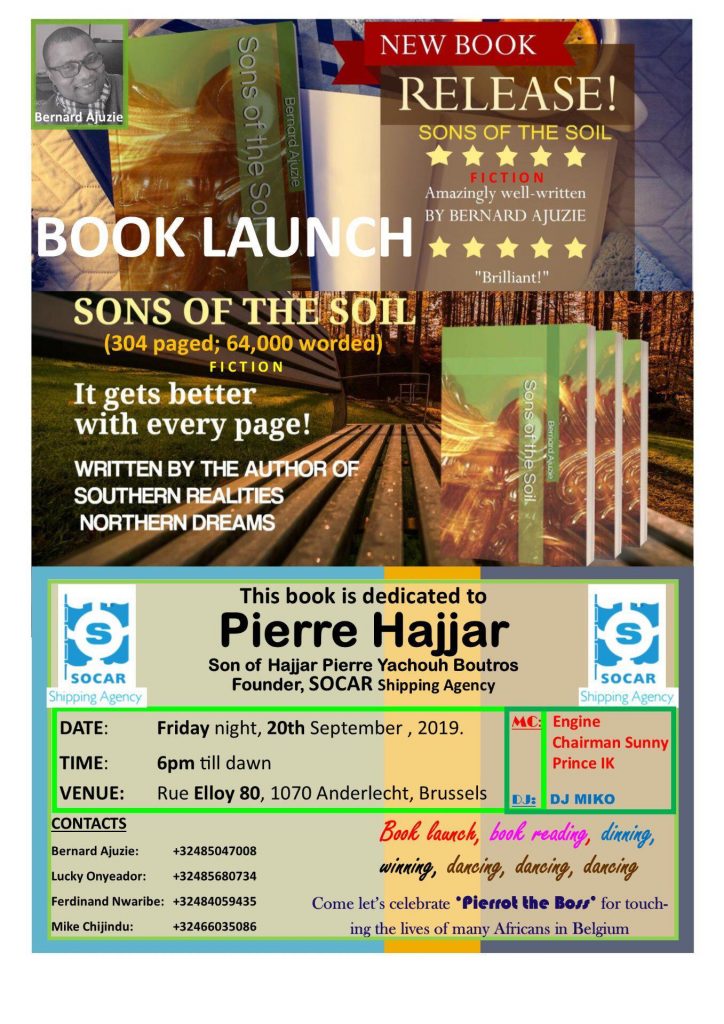
I am honoured to offer some commentaries as a Reader at the book launch of Ben Ajuzie in Brussels, Belgium on Friday, 20 September 2019. I make bold to conclude that the work of fiction is an enrichment of the Belgo-Afro literary landscape.
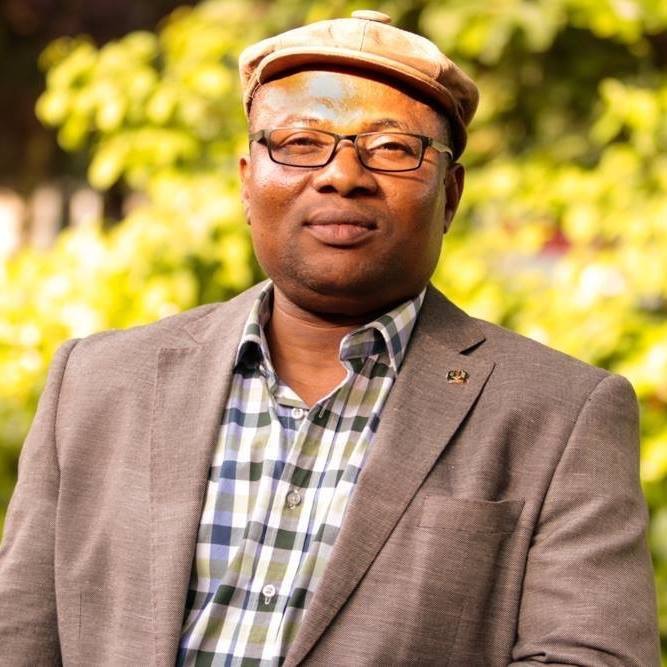
Author Bernard (Ben) Ajuzie, Sons of the Soil

The world of literature will be richer on Friday 20 September 2019 with the official launch in Brussels, Belgium of the work of fiction “Sons of the Soil”. Authored by Bernard (Ben) Ajuzie, himself a study in diversity, Sons of the Soil holds a mirror to humanity. Through this mirror we are able to view ourselves from diverse prisms. 

In reading even just a part of Sons of the Soila kaleidoscope of self-evaluating questions can’t help but whirl up your head: am I the concerned father that also happens to be King of Sumanguru Kingdom, one of the principle characters of the over 300-page fiction? Do I best fit in the shoes of Gawiwy, Dr Banjo or Gabito, the master schemers? How much does Chubido, the loyal friend mirror my personality? Could it well be that my exterior defeats my inner calm, a different set of ambitions and a near zero sense of worldliness, making me the Prince Jeje of our time; heir apparent to the Sumanguru throne with no ambitions for the crown? How much does Chief Tirie represent my ambitious uncle, who would stop at nothing to get that which he sets his eyes on, undermining all and crushing everything that stands on his way? 

In more ways than one, there are Sons of the Soil in us all, be it in our daily lives as ordinary mortals or as parts of a cabal that constitute present day politics and politicking or community set-ups. Considering that Sons of the Soil speaks candidly to us all, it is a reference work to own. 

As the saying goes, different strokes for different folks! Readers are bound to make their individual assessment of the literary style deployed by Ben in this latest work, either in isolation or in comparison with his first book “Southern Realities Northern Dreams”. I for one see in Ben with his latest literary outing, a writer that is dramatically coming of age. I will not belabor you with neither volumes nor details but allow me the latitude to consider this oxymoron I extracted from page 301, and it reads “Chief Tirie laid face down and the earth appeared to shield it from the shame it refused to embrace when he was dealing other people…”  Before that, on page 300 to be precise, he had painted a literally picture of a Chief whose past would not let loose. Hear this “The Chief’s latest fear was not his failure to achieve, but the idea that the gods are on the hunt following his vows before the oracles”. Even poets and fans of poetry would have a field day with Sons of the Soil published by the National Library of Nigeria. An overzealous man had done everything and stopped at nothing to achieve his innocuous ambitions, knew that he had stepped on too many toes and made uncountable enemies. Will he be glorified, any legacy to celebrate? Perhaps not hence before drawing his last breath, he had this poetic rendition to spare:

“All who wish me gored

Are free to come forward

And party my end”

If I could indulge you a little more, allow me dwell for a brief moment on where the author, Ben Ajuzie derived the impetus to deliver such masterpiece of literature. As averred earlier on, Ben is a study in diversity. A Nigerian of Igbo extraction, his early influences are to be found in Limbe, West of the Cameroons, Accra and Anloga in Ghana where he enjoyed his secondary education before a homeward journey back to his home state of Abia in Nigeria. At the State University there in a semi-rural, semi-urban town of Uturu, he bagged a bachelor’s degree in Food Science & Technology. Thereafter, like his character Jeje, a sojourn away from Africa, brought him to Belgium’s Vrije Universiteit, Brussels for dual Masters, one in Human Ecology and the other a master’s in educational research & Psychology.  Ben’s rich and diverse background is a baggage that informs but also enriches his literary outing. 
Worthy of final mention is the crossover elements in Sons of the Soil. The setting of the fiction may understandably be Africa, but the fact of the writer maturing in Europe is evident in his coinages, metaphors and the oxymorons that dot the novel here and there. It is only fair to assert that this work is an interesting, if not a curious addition to the Belgo-Afro literature, which at present is in its infancy. My assessment is that Sons of the Soil leaves the first-generation African Diaspora and their European friends and family with nostalgia while their children, the second-generation Diaspora, will find in the book, tales of the influences that shaped their dads and mums, uncles and aunties. 

Commentary by Collins Nweke

Ostend, Belgium