AKU LUO UNO

Reimagining Diaspora Wealth as Strategic Capital for Homeland Development

Abstract for a keynote speech at the Imo Community Europe 2026 Annual Convention in Freiburg, Germany on Saturday 2 May 2026

 by Collins Nweke

The Igbo philosophical construct aku luo uno, literally translated as “may wealth reach home” has long served as a moral compass guiding the relationship between individual success and communal responsibility. Historically, it affirmed a simple but powerful proposition: prosperity achieves its fullest meaning when it is reinvested in one’s place of origin. In contemporary times, however, the meaning of aku luo uno demands both preservation and reinterpretation.

This presentation situates aku luo uno within the broader framework of diaspora economic diplomacy, arguing that what was once a cultural expectation must now evolve into a structured development strategy. The modern Igbo diaspora is no longer defined solely by remittances or symbolic homecoming projects, but by its capacity to mobilise capital, knowledge, networks, and institutional influence across borders.

Drawing from the central thesis of Economic Diplomacy of the Diaspora (Nweke, Collins, 2026) the presentation advances three interconnected arguments. 

First, that diaspora wealth must be understood not merely in financial terms, but as a composite of economic, intellectual, and relational capital.

Second, that the effectiveness of aku luo uno depends on moving from fragmented individual efforts to coordinated, scalable interventions, through investment platforms, policy engagement, and partnerships with credible institutions. 

Third, that sustainable impact requires a shift from consumption-driven remittances to production-oriented investments capable of generating jobs, infrastructure, and long-term value within Imo and Southeast Nigeria.

The discussion will also confront the tensions embedded in the philosophy: the pressure of expectation on diaspora individuals, the risks of poorly structured investments, and the governance gaps that often undermine trust. In doing so, it seeks to move the conversation from obligation to strategy, from sentiment to systems.

Ultimately, aku luo uno is reframed not as a nostalgic ideal, but as a forward-looking doctrine, one that positions the diaspora as a decisive actor in shaping the economic future of its homeland. The question is no longer whether wealth should return home, but how it can do so in ways that are intelligent, impactful, and enduring.

Collins Nweke 

Ostend, Belgium | www.collinsnweke.eu | admin@collinsnweke.eu

———————————————————————————-

THE SPEECH 🎤

Aku Luo Uno: When Wealth Finds Its Way Home

Distinguished leaders of the Imo Community Europe,

Your Excellencies, honoured guests,

Ndi Imo, umunne’m,

There are certain phrases in our Igbo language that do not merely communicate. They command.

They carry memory, expectation, and judgment all at once.

Aku luo uno is one of them.

It is not just a proverb. It is not even just a philosophy.

It is a quiet but firm question that follows every Igbo person, wherever they go in the world:

When your wealth has grown… will it remember the road home?

For generations, our people have understood success in a way that is both deeply personal and profoundly communal. A man may build towers abroad, earn titles, command influence. But there is a simple test that awaits him at home. Not harsh, not loud, but unmistakably clear:

Who have you lifted? What have you built? What remains of you here?

And so we grew up hearing and believing that if a person is known all over the world but not known in his hometown, then he is, in truth, not yet known.

That is the moral architecture of aku luo uno.

But today, standing here in Europe, we must ask ourselves an honest question:

What does aku luo uno mean in our time? What imperatives of our time does aku luo uno denote?

Because the world has changed. And so must our understanding.

From Obligation to Strategy

In the past, aku luo uno often expressed itself in visible, immediate ways.

A house built in the village.

Support for extended family.

Community projects: wells, town halls, scholarships.

These were noble. They still are.

But today, they are no longer sufficient.

Because the scale of the challenge at home has changed. And the capacity of the diaspora has also changed.

We are no longer a scattered people sending money home.

We are professionals, entrepreneurs, policymakers, researchers, investors, innovators.

We sit in boardrooms, universities, institutions, and governments across Europe and beyond.

Which means this:

Our wealth is no longer only what we earn. It is what we know, who we know, and what we can influence.

So aku luo uno must evolve, from a moral obligation into a strategic instrument.

What Does It Mean for Wealth to Truly “Come Home”?

Let me suggest three shifts.

First: From Money to Capital

When we say aku, we often think of money.

But money alone does not transform societies.

Capital is broader.

It includes:

  • Knowledge
  • Skills
  • Networks
  • Access
  • Credibility

If you bring money home without systems, it disappears.

If you bring knowledge and structure, it multiplies.

So the real question is not: How much have you sent home?

But: What have you built that can outlive you?

Second: From Individual Effort to Collective Impact

One of our strengths as Igbo people is individual enterprise.

But one of our limitations is fragmentation.

Too many of us are doing small, disconnected things.

Building in isolation. Investing without coordination.

Meanwhile, the problems we seek to solve: industrialisation, healthcare, education, infrastructure,…  are not small problems. They require scale.

So aku luo uno in our time must become collective.

Not just:

  • my project

But:

  • our platform

Not just:

  • my success story

But:

  • our shared transformation

We must begin to think in terms of:

  • Diaspora investment clusters
  • Structured partnerships with credible institutions
  • Long-term projects, not one-off interventions

Because scattered drops of water cannot build a river. As we talk of aku luo uno, let us remember also that: anyu kosia mamili onu, ogba ofufu. Do I need to explain further? Mba nu! 

Third: From Consumption to Production

Let us be candid with ourselves.

A significant portion of what we send home is consumed.

Celebrations. Buildings that do not produce value.

Short-term relief without long-term impact.

But no society develops through consumption.

Development comes from production:

  • Businesses that create jobs
  • Systems that generate value
  • Investments that compound over time

So when wealth returns home, it must not only be seen. It must be felt economically.

It must employ people.

It must create opportunity.

It must shift the structure of the local economy.

That is when aku has truly luo uno.

The Difficult Truths We Must Confront

But let us not romanticise this journey.

There are real tensions.

Many in the diaspora have invested and lost:

to poor governance, weak institutions, corruption, inefficiency, broken trust… It is a long list!

Others feel overwhelmed by expectations:

as though success abroad automatically makes them responsible for everything at home.

And some have simply withdrawn:

choosing distance over disappointment.

These are not trivial concerns. They are real. They have affected real Ndigbo. They still affect Umu Imo…

But here is the truth:

No society develops in perfect conditions.

Society develops because people decide to build despite imperfection.

The answer is not withdrawal.

The answer is structure, collaboration, and smarter engagement.

A New Interpretation of Aku Luo Uno

So perhaps it is time to reinterpret the proverb.

Maybe aku luo uno should no longer be understood as:

“Bring your wealth home.”

But rather:

“Let your wealth find intelligent pathways home.”

Pathways that are:

  • Structured
  • Scalable
  • Sustainable

Pathways that transform not just families, but communities.

Not just communities, but systems.

Conclusion: The Road Home Is Still Calling

Ndi Imo, umunne m,

No matter how far we travel, there is something about home that does not travel with us.

It waits.

And in that waiting, there is a quiet expectation. Not of charity. But of contribution.

The question before us is not whether we have succeeded abroad.

Many of us have.

The question is:

Will that success remain personal…

or will it become purposeful?

Because in the end, aku luo uno is not about geography.

It is about legacy.

It is about ensuring that when our story is told,

it is not only said that we went far…

But that something meaningful followed us back home.

Thank you. Dâlu nú Umu Imo.
Jisinu Ike Ndigbo! 

The Culture Bridge We Try to Build

I am a (grand)father. But long before that, I was a first generation diaspora. I carried not just a suitcase. Instead, I brought a whole continent of stories, customs, fears, and hopes. I carried them across the ocean, from Nigeria to Belgium.

Crossroads of heritage

When I arrived in Europe, I knew I was entering a world that spoke a different language. Not just French or Dutch or German. But a language of culture, of history, of what it means to belong. And yet, I stayed. I worked. And we raised a family.

Our sons were born here. Belgium is the only home they have ever truly known. From the time they were old enough to walk, we tried to raise them on two legs. One planted in the orderly cobblestones of Europe, and the other in the red earth of our Igbo heritage. We visited Nigeria reasonably often. Christmas in Lagos, New Year in Ichi, Nnewi. Easter in Abuja, Iwaji and Ifejioku back in our Igbuzo hometown. They drank Zobo. But also Fanta in glass bottles, tongues painted orange, to their delight. And they learned to greet elders in Igbo: Omogwu, Oliofe, Akukalia, Amuapa,…They knew the songs. They danced at Ibunmanya traditional marriages. They buried their fingers in pounded yam and egwusi soup. They sometimes even asked for more jollof rice.

But by the time the older son turned 15, the visits stopped.

Nigeria had started changing. But they also started making their own Easter, summer, and Christmas plans with their friends.

Did Nigeria really change or it revealed more of what it had always been: fragile, violent, neglected? Our homeland still wakes early to call upon the ancestors on our behalf. My own father is now nearing the sunset of his life at 98. Meanwhile, mother’s mother, 101, in Ichi, still remembers the Biafran war like it was yesterday. But today, we can’t even say for certain they are safe.

My son is now a father himself. His son – my grandson – is five. A lively, curious boy with the wild laughter of a hyena cub and the soft curls of his Belgian mother. My son wants him to know Nigeria too like he did. He wants to stop and show him the Atakpo river before entering Igbuzo. He’d like to take him to Okpuzu river and drink from the stream. Maybe even wash his head and face, calling on goddess Oboshi to take charge, fight his battles. He probably wants to take a dive into the river like I did with him. He wants to have his head touched and blessed by the great-grandparents whose blood runs in his veins. But the road home no longer feels like a road. It feels like a battlefield.

“Daddy,” he said to me yesterday over breakfast, voice low, pained. “How do I take my wife and son into a country where churches are bombed? Roads are unsafe, and children are kidnapped from school?” How can I explain to my Belgian wife? She doesn’t understand. It is considered fine when a police officer points an AK47 at you at a traffic checkpoint. The officer’s eyes are deep red and stone-faced. Yes I survived it. It felt cool to me at the time because I had seen it in Nigerian films. Nollywood playing out live. Yes, I saw it often in the Naija movies. You and Mummy watched these films. You got us to watch them too. It served as a partial introduction to our ancestral homeland. They do not have all of that orientation”

I had no answer. I am his father. Fathers are supposed to have answers. Frustrating!

Instead, I gave him what we fathers often give when our strength fails: perspective wrapped in silence. I tried to tell him, gently, that we are not the only ones caught between worlds. Sometimes, we must carry our culture not in our luggage. We carry it in our habits, in our stories, and in how we name our children. I reminded him that we named him Tonna and his brother Chidi. We must carry our culture in what we teach them to love.

Still, I see the ache in his eyes. The guilt of a son who can’t take his own child to see his roots. The fear that something irreplaceable is being lost in translation.

He loves Nigeria as a land and the people in it. He blames Nigeria, its broken politics, its indifferent governance. He even praises Ibrahim Traoré of Burkina Faso. I don’t blame him. Nigeria has failed many of us, repeatedly. Yet I find myself defending the homeland still. Not out of naivety. But out of something older: loyalty, or the stubborn refusal to give up on the soil that birthed me.

My grandson asks, “Nnanna, where is Nigeria?” and I tell him, “It’s where your name Nweke comes from. It’s the reason you dance so well. It’s the energy in you and the loudness of your laughter. It’s the place where your great-grandma sings to the moon and greatgrandpa pours libations to the gods. My mother, your Nne-Nnanna of blessed memory, rests there.”

I don’t know if he understands. But I hope one day he will. I also nurse the distant hope that he will someday meet his great-grandparents before they join Nne-Nnanna and their ancestors.

This story is not just ours. It belongs to millions like us. African families straddling two continents, trying to stitch together identity with threadbare fabric. Europeans raising children with heritage they barely comprehend. Diaspora parents mourning the loss of what they couldn’t pass on, and children resenting what they never received.

But here’s the truth: culture does not die in silence. It dies in forgetting.

So, we must keep remembering. We must keep telling the stories, even if we can’t visit the places. For now! We must cook the food. We must speak the names. We must light the ancestral candles. We must even pour libations that we do not fully understand or agree with their import. And then, we must hope that one day; when the guns fall silent and the roads are safe; our children and their children can walk back across the bridge we’ve spent our lives trying to build.

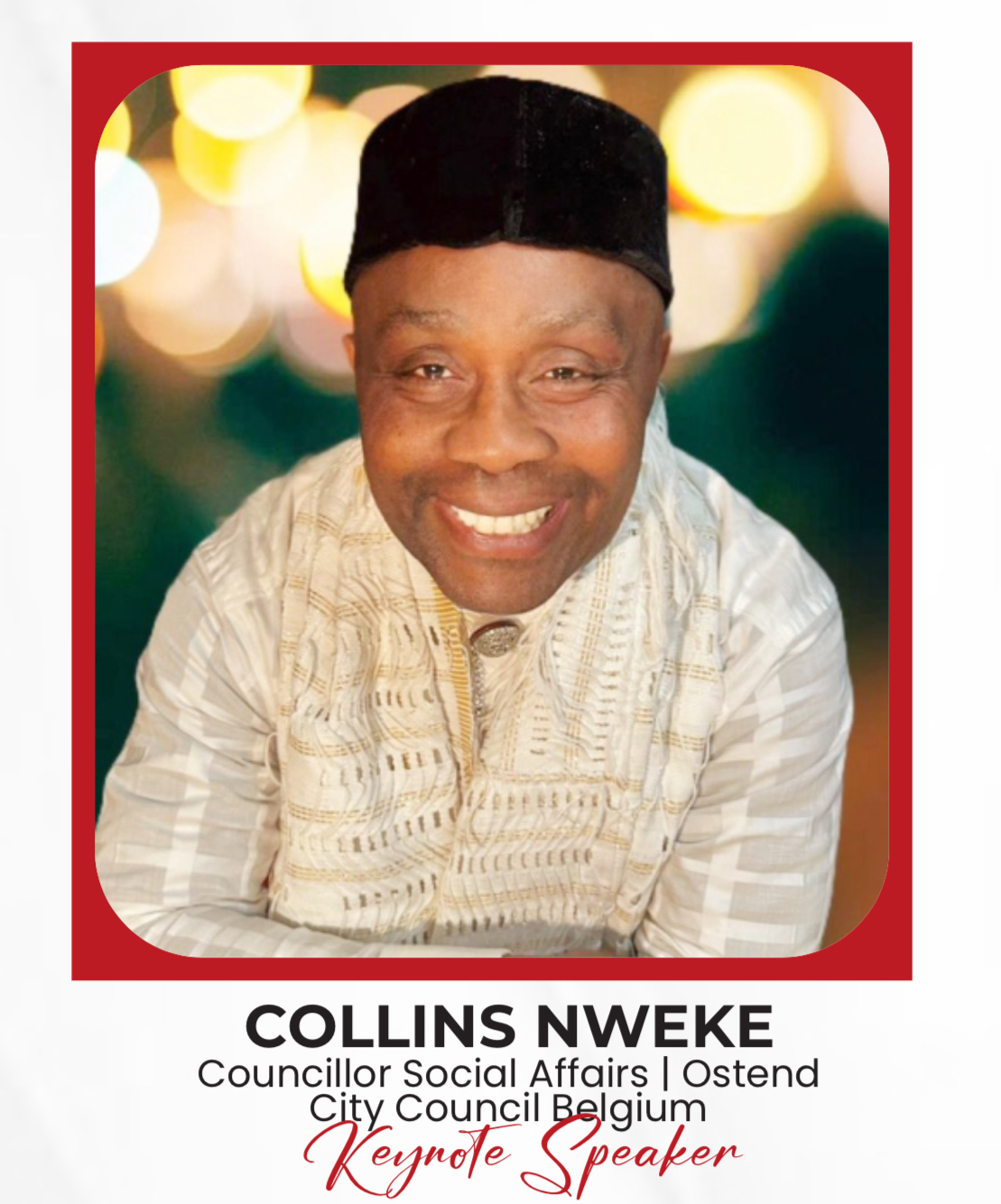
The author, Collins Nweke is Belgian of Nigerian roots. A former Green Councillor at Ostend City Council Belgium, he is a husband an active father and grandfather.

Keynoting Omenaimo 2024

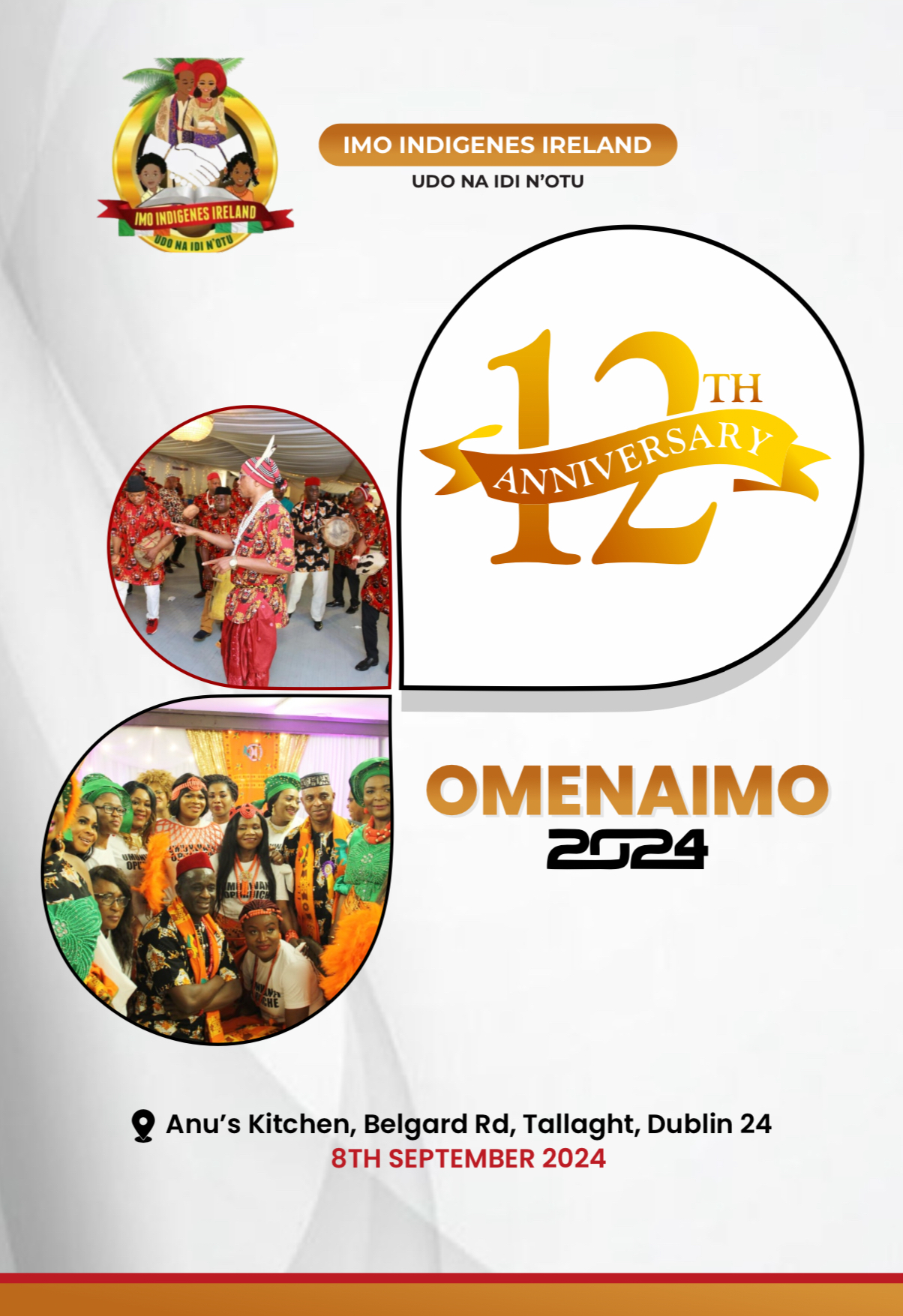
I’ve never had to give a public talk about being Igbo. That will change on Sunday 8 September when I will be keynoting Omenaimo ImoDay 2024 in Dublin Ireland.

I’d be deploying some personal narratives and some social theories in a storytelling format to try to do justice to the topic of #inculturation #identity #culture #interculture. Here is a pretaste of what #Umuimo #Ndigbo and #Nigerians in Ireland 🇮🇪 can expect from me:

When Mazi Utuagbaigwe insisted that he is not giving Adaeze’s hands in marriage to his Belgian son-in-law, if he does not perform the Igba Nkwu rites, was he being insensitive to the culture of his host country or being chauvinistic? Can it be judiciously argued that inviting his in-laws to negotiate his daughter’s bride price is an affront to European laws and culture? And what about his rebuke to his daughter and her husband that among the Igbos, marriage is an affair for both the immediate and extended family and he cannot have any of them question whoever he decides to identify as that extended family? What about tutoring his son-in-law that under no circumstances should he even think of calling him or his Lolo by their first names, he must call them what he hears Adaeze calls them! How does any of these strongly held positions hamper integration into their host community in Europe?

Swapping Shoes: sofa talk between a European and an African

People treat you differently if you don’t know the language. Condescendingly, as if you’re a child. An aunt from the Flemish side of the family once even said, “I keep forgetting you have a university degree” – Chika Unigwe

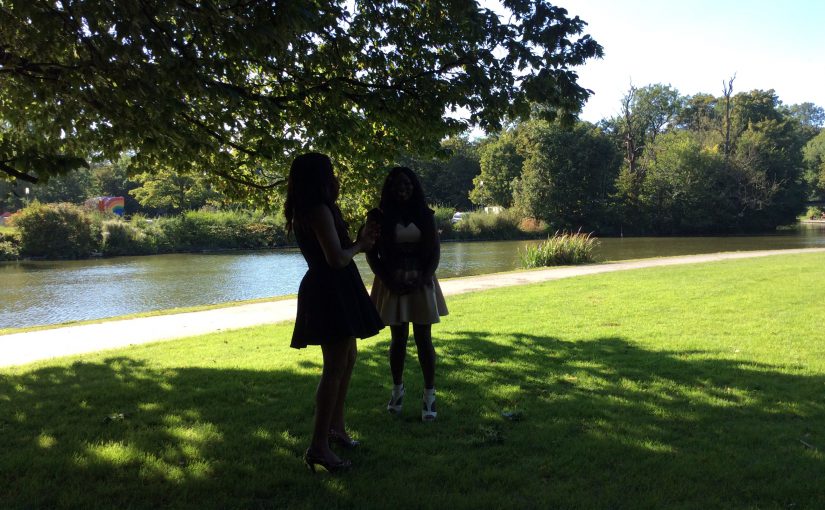
When two professional women settle into the sofa for a chat, it is expected to be deep. So it was between Femke van Zeijl and Chika Unigwe. Femke grew up in a Dutch village, some 40 kilometres away from Turnhout, the Belgian town where Chika migrated to in 1995. On her part, Chika grew up in Enugu, a town in eastern Nigeria. The irony is that in 2012, the migration turn fell on Femke who settled in Lagos. The purpose of the sofa talk between the two divas was to compare notes on their migration experiences. Thereafter here is Femke’s footnote on the conversation “I confess that Lagos’ noise sometimes makes me crave silence. Chika likes the liveliness she is used to from back home. She prefers to write in a crowded café and never goes looking for quietness. For a moment I find myself longing for half an hour of silence in her Turnhout street”


Femke van Zeijl: You describe migrating to Belgium as ‘losing your voice in small imperceptible ways’. What do you mean by that?

Chika Unigwe: It seemed I had to learn everything all over again. All etiquette and forms of politeness, as if I was a child again. I certainly made as many mistakes as a child. It started with my first breakfast at my in-law’s house. I was still in bed when I was sent for: everyone was at the table waiting for me. My Flemish family had breakfast together at the dinner table, and I was supposed to be present. Whereas I can’t remember we ever had dinner together at the table back home in Enugu. At our place, you ate when you were hungry. With your plate on your lap, wherever you wished.

Femke van Zeijl: I on the other hand always waited here in Lagos until everyone had food on their plates, as my parents taught me. But that would invariably lead to a Nigerian inquiring whether I did not like the food.

Chika Unigwe: You have the advantage of speaking a language many people in your new country understand. I did not speak Dutch at the time. That first year in Belgium was very hard for me. I do not like to be reminded of that period. People treat you differently if you don’t know the language. Condescendingly, as if you’re a child. An aunt from the Flemish side of the family once even said, “I keep forgetting you have a university degree”.

FZ: I notice that I get away with things because I am a stranger. Nigerians figure I don’t know all the customs and sensitivities, and so they are forgiving when I make a faux pas. Is that your experience as well?

CU: No, in that sense Africa and Europe are extremely different. In Belgium you are expected to integrate, preferably assimilate. To whisk away your own culture as much as possible. You are supposed to eat chips with mayonnaise, like a proper Belgian. People prefer to hear that you like that more than your own food from home. Then you are a successful migrant. When a European comes to Africa though, nobody expects of him that he will integrate or assimilate. On the contrary: the biggest African ghettos are the compounds where white people live. You are an exception, Femke. You want to get to know the people and are living amongst them.

FZ: Sounds like I am having an easier time in Lagos. When I have amala in a local buka, the whole neighbourhood gathers to come see the miracle. And the little advantages I undeservingly get thrown for being white… The other day the personnel of a bank wanted to have me cut a very long Friday afternoon queue to be helped first. I was so embarrassed.

CU: When a white person migrates to Africa, he is going from a position of power, to power. An African coming to Europe lands from power into powerlessness. We Africans cannot do much with our diplomas here. Once I had learned Dutch and went to the job centre, they offered me a position as a cleaning lady. And in the shop it happens regularly that someone follows me around to check that I am not stealing anything. In expensive boutiques I might not even get served. The sales personnel assume I cannot afford to buy anything anyway. Whereas a white person in Nigeria, even if he has no skills whatsoever, always gets opportunities. No Nigerian would dream of offering you a job as a cleaning lady.

FZ: How did you overcome your initial powerlessness?

CU: By learning the language. The more I mastered Dutch, the less lonely I felt. I became more self-assured, which yielded me more respect. Language makes you independent and gives you a voice. And with that voice you can even change people’s views, because a stranger teaches you to look at yourself in a different way. A while ago I was interviewed on Belgian radio about classical music. Back home we never listened to that, and the first remark of the presenter was ‘So you did not have a culture of music at home?’ So I asked her: ‘Do you know highlife music? No? Well, my father always listened to that, and would consider you a barbarian because you have never heard of it.’ She had never thought of it that way. There is no absolute standard for civilisation; it is different for each culture.

FZ: Does your integration into Flemish society resonate in your work?

CU: My first novel was staged in Turnhout, close to my new home. The second was about Nigerian women in Antwerp and in my third book I returned to Nigeria. By that time I had fully regained my voice. My new book that has just been published covers an entirely different matter: a former slave in the eighteenth century.

FZ: Nigeria has taught me to add ‘Sir’ and ‘Madam’ to my sentences. Forms of politeness are still much more observed here then in The Netherlands. Are there things your new country has taught you?

CU: When my husband’s uncle was on his deathbed, the entire family was called to come and say goodbye. Very beautiful. That would never happen in Nigeria. Even if you are ninety, everyone keeps praying for a miracle. Death is much less of a taboo in Belgium. I find that very pleasant.

FZ: You are one of the few people who didn’t consider me nuts when I decided to move to Nigeria.

CU: Lagos is not an easy place to live in. When you told me you wanted to live there, I thought you were brave. But then again, that is what my sister said of me when I moved to Belgium with my husband nineteen years ago. We both followed our dreams. There are many too afraid to do that. Migrating is an act of courage.

hThe power is cut on my side, and all around my two-bedroom apartment generators start rumbling. I confess to Chika that Lagos’ noise sometimes makes me crave silence. She laughs. Chika likes the liveliness she is used to from back home. She prefers to write in a crowded café and never goes looking for quietness. For a moment I find myself longing for half an hour of silence in her Turnhout street.

**********************************************

Chika Unigwe grew up in Enugu, a town in eastern Nigeria. There she met her Belgian husband, with whom she migrated in 1995. Her fourth novel, The Black Messiah, was recently published in Dutch. For her second book, On Black Sister’s Street, she received The Nigeria Prize for Literature. Chika lived with her husband and four sons in the Flemish town of Turnhout but has recently made another big move as she and her family migrated to the US.

Femke van Zeijl grew up in Berkel-Enschot, a village in the Dutch South about forty kilometres away from Turnhout. For the past eleven years she has traveled sub-Saharan Africa as a freelance journalist. She has written two books based on her reporting. The second, Gin-Tonic & Cholera, is about urban life in Africa. In 2012 she settled as a freelance correspondent for Dutch media in Lagos, a city that is estimated to have more inhabitants than her country of birth.

source: Brittle Paper article “Strangers in Each Other’s Countries: A Discussion with Chika Unigwe” by Femke van Zeijl