
The Venezuela Crisis Through an African Non‑Interference Lens

“In reality, Africa has articulated one of the most sophisticated normative frameworks on sovereignty and intervention outside Europe. The Venezuelan invasion calls for the deployment AU Doctrine, Strategic Non-Alignment, and choosing diplomacy over coercion”  – Collins Nweke

The evolving crisis in Venezuela is often framed as a distant Latin American drama, but for Africa, that would be a profound misreading. What is unfolding in Caracas is far more than a contest over Nicolás Maduro or a reaction to United States policy choices. It is a stress test of global norms in an increasingly fragmented international order. Viewed through Africa’s long‑established doctrine of sovereignty, non‑interference, and non‑indifference, the crisis exposes the same dilemmas the continent has repeatedly confronted in Libya, the Sahel, and other externally shaped theatres of instability. 

Africa is not merely a bystander to these debates. It has articulated one of the world’s most sophisticated frameworks on intervention and state responsibility. It is seen as a framework born from hard lessons about the costs of both indifference and coercive external involvement. The Venezuelan crisis thus becomes a mirror, reflecting the stakes for African states as global powers stretch, reinterpret, or selectively apply international rules. Its implications reach far beyond Caracas. They speak directly to Africa’s strategic autonomy, its commitment to diplomacy over coercion, and its insistence that sovereignty must coexist with accountability.

Africa Is Not Normatively Silent

Africa is often caricatured as reactive in global affairs. In reality, the continent has articulated one of the most sophisticated normative frameworks on sovereignty and intervention outside Europe. The African Union is built on a carefully negotiated doctrine that seeks to reconcile state sovereignty, collective responsibility, and human security.

The AU Constitutive Act establishes, on the one hand, the principle of sovereign equality and non-interference in the internal affairs of member states. On the other, it introduces a distinctly African innovation: the right of the Union to intervene in grave circumstances such as war crimes, genocide, and crimes against humanity. This was not a rejection of sovereignty, but a refinement of it. This was born of Africa’s painful experience with indifference during mass atrocities.

The Lomé Declaration on Unconstitutional Changes of Government (2000) further clarified Africa’s red lines. It rejected coups, mercenary interventions, and externally engineered seizures of power, while insisting that political change must be constitutional, inclusive, and domestically anchored. Importantly, Lomé did not license regime change by foreign powers. It asserted African ownership over political legitimacy.

Together, these instruments amount to a coherent African doctrine: non-interference without non-indifference; sovereignty without impunity; and reform without coercion.

Diplomacy as First Resort, Not Last Option

Africa’s practical diplomacy has reinforced this doctrine. AU-led and AU-mandated mediation efforts have consistently prioritised dialogue, negotiated settlements, and regional legitimacy over punitive or militarised approaches. Examples abound from Sudan and South Sudan to Kenya, The Gambia, and parts of the Sahel. While outcomes have been uneven, the underlying lesson is clear: durable political settlements emerge from inclusive processes, not externally imposed outcomes.

This preference for diplomacy over coercion is not weakness. It is strategic realism. Coercive sanctions regimes and forced political outcomes often hollow out institutions, radicalise domestic actors, and internationalise internal conflicts. Venezuela’s protracted crisis illustrates this danger vividly.

For Africa, the Venezuela case reaffirms a long-held conviction: defending sovereignty does not mean defending misrule; rejecting regime change does not require silence on accountability; and supporting democracy does not justify abandoning international law.

Strategic Non-Alignment in a Multipolar Order

China’s stance on Venezuela is less about ideology than about signalling a multipolar world. For African states navigating relationships with the United States, China, the European Union, and emerging middle powers, this moment underscores the urgency of strategic non-alignment. This implies that cooperation can exist without subordination.

Non-alignment today is not Cold War nostalgia. It is about policy space. Africa’s interest lies not in choosing sides, but in strengthening its collective voice through the AU. Fragmented national positions dilute Africa’s leverage. Coordinated continental postures enhance it.

Acting through the AU, African states can:

  • Uphold respect for sovereignty and constitutional order
  • Demand consistency in the application of international law
  • Engage all partners including Washington, Beijing, Brussels, and beyond, on equal terms
  • Anchor external relations firmly in the principles of the United Nations Charter

Resources, Legitimacy, and the Venezuela Lesson

Venezuela’s vast oil reserves offer Africa another cautionary lesson. Natural resources are not power by default. They become leverage only when matched with institutional legitimacy, credible governance, and effective diplomacy. Absent these, resource wealth attracts external pressure rather than strategic respect.

Africa has learned this lesson repeatedly. The continent’s future resource diplomacy must therefore be anchored not only in extraction, but in governance, legitimacy, and multilateral engagement.

A Pro-African Call to Action

For Africa, the implications of Venezuela’s crisis are neither abstract nor distant. They are immediate and strategic:

  • Defend sovereignty without legitimising misrule
  • Reject externally imposed regime change while insisting on accountability
  • Champion AU-led diplomacy and mediation as first resort
  • Converge under the African Union to practice principled non-alignment
  • Insist on respect for international law and the UN Charter by all powers, without exception.

In an era where global rules are being selectively applied and routinely stress-tested, Africa must stand firm on multilateralism as the currency of legitimacy. Anything less risks a regression to a world where might defines right. Africa has lived through that era. It cannot afford its return, whether in Caracas, Tripoli, Abuja, or closer to anywhere called home on the continent.

Deploying the Belgian Art of Consensus in the European Debacle over Frozen Russian Asset

by Collins Nweke

At moments of historic pressure, nations are judged not only by the positions they take, but by the solutions they propose. The current European debate over frozen Russian assets, crystallised at a crucial EU summit, is one such moment. Belgium now finds itself at the intersection of legality and leadership, national prudence and European purpose.

The question confronting Europe is deceptively simple: should frozen Russian state assets be mobilised to support Ukraine? The answer, morally and politically, is already clear across much of the continent. Ukraine’s survival is inseparable from Europe’s security. What is contested is how Europe should act. More than that is who bears the risk.

Belgium’s caution has been widely interpreted, in some quarters, as hesitation. That reading is incomplete. My reading is that Belgium is not resisting European solidarity. It is warning against a model of solidarity that concentrates systemic risk in one member state simply because history and infrastructure placed the assets there. This is not obstructionism as some would like to simplistically label it. It is institutional realism.

As home to Euroclear, Belgium is custodian to a significant share of the frozen Russian assets. That custodianship carries legal exposure, financial vulnerability, and geopolitical risk. Any unilateral move that leaves Belgium or Euroclear bearing the brunt of litigation, retaliation, or reputational damage would be neither fair nor European. In a Union built on shared sovereignty, shared risk must follow shared ambition.

This is where Belgium’s political tradition offers Europe a way forward. Consensus-building is not weakness; it is statecraft. Belgian politics has long thrived on crafting outcomes that allow divergent interests to converge without humiliation or coercion. Europe would do well to draw from that tradition now. But Belgium would have to create the enabling environment for that to happen.

A credible European solution must rest on one foundational principle: Europeanise the risk, not merely the decision. If Europe chooses to act collectively, then the legal and financial consequences must also be collectively borne. A binding EU-level indemnity mechanism  would ensure that no single member state becomes the fall guy for a European geopolitical choice. This must be anchored in a Council decision or regulation. It should not be seen as special pleading by Belgium. It is a test of European maturity.

Second, Europe must separate urgency from recklessness. There is already a lawful pathway that commands broad support: the use of windfall profits generated by frozen assets. Expanding this channel allows Europe to continue supporting Ukraine decisively while the more complex legal architecture around principal assets is clarified. Acting responsibly need not mean acting slowly.

Third, this debate exposes a structural weakness the EU can no longer ignore. Ad-hoc improvisation is no substitute for institutional readiness. Europe should seize this moment to establish a permanent EU-level sovereign assets mechanism. This is a framework that governs frozen state assets under strict political and legal thresholds. Such an instrument would remove hostage risk from individual member states and ensure that future crises are met with preparation, not panic.

For Belgium’s Prime Minister, Bart De Wever, the path forward lies not in retreat, but in reframing. Belgium should say, clearly and publicly,  that it supports the objective of mobilising Russian-linked resources for Ukraine, provided Europe acts as Europe. That means unity not only in rhetoric, but in liability, governance, and protection of strategic infrastructure.

This is the win-win Europe needs. Belgium retains its legal and financial integrity. Europe gains a sustainable, credible mechanism to back its geopolitical commitments. Ukraine receives continued support without undermining the legal order Europe claims to defend.

In the end, the choice is not between Belgian national interest and European common interest. Properly understood, they converge. A Europe that asks one member state to carry disproportionate risk is not a stronger Europe; it is a fragile one. Conversely, a Europe that mutualises responsibility is a Europe capable of leadership.

Consensus, after all, is not the art of delaying decisions. It is the discipline of ensuring that when decisions are taken, they endure. Belgium should help Europe rise to that standard. It should rise to this occasion not by saying no, but by showing how to say yes, together.

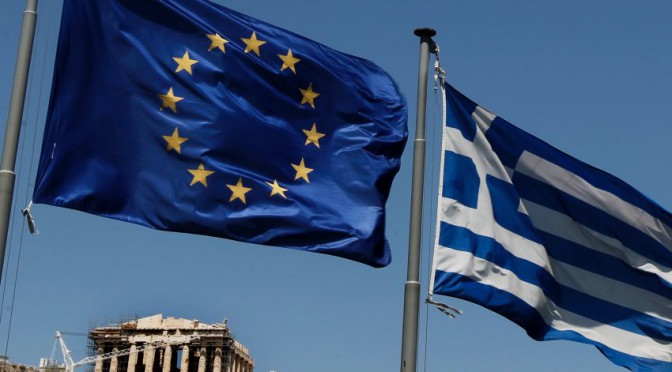
Europe – an even bigger failure than Greece

Earlier in the evening I took a few minutes to study and sign an online petition on the Greece debt crisis. I also made the bold statement of changing my Facebook profile picture to a sticker expressing solidarity with the Greek people. As I went back to the desk to complete a report with an imminent deadline, I had problems concentrating because of the numerous questions and thoughts that kept whirling round inside my head about Greece. I am supposed to resist the urge to write about the unfolding menace until after the Sunday referendum, I reminded myself. What’s the point of waiting? The referendum won’t change everything, would it? And anyway, I need to clear my head of these nagging questions, these thoughts…

The founding fathers of the EU will be turning in the grave right now pondering about what has become of the Union they created? As if the inhuman treatment of refugees in the Mediterranean isn’t enough naked dances in the market square, there are subtle, yet concerted efforts now by the traditional conservative powers to oust the popular Syriza Government of Greece through sabotage. Truth be told, no government within the European Union has ever dared challenge the status quo in the manner that the current Greek government is doing. They are feared as the biggest threat to renewed growth, job creation, economic prosperity, political integration and peace in Europe. That is untrue and it reminds me of a Nigerian Igbo adage to the effect that when a peer fetches better firewood, he’s accused of fetching those in a forbidden evil forest. The truth is to be found in the story of how Greece got to where they currently are.

So how did the Greeks get here?

After Greece joined the monetary union of Europe in 2001, the tiny country of 10 million (about same population as Belgium and smaller than Lagos State, Nigeria) was flooded with money from elsewhere on the Continent. Over the course of the decade that followed, Greek leaders, who can’t be said not to be corrupt, ran an economy long rife with patronage and tax evasion. They borrowed billions from their imprudent friends at European banks, and then perfected a culture of non-disclosure to EU officials about mounting debts. When the financial crisis finally rolled into Greece in 2009 and 2010, the country was in an estimated $430 billion in debt[i], a staggering figure that imperilled the economic health of its near and distant neighbours — indeed, all of Europe. The European Commission, International Monetary Fund and the European Central Bank (often referred to as the Troika) agreed to bail out the sinking economy by loaning it $146 billion. The bailout was not without a price tag, which was fixed by the bailers (Troika) and signed by the bailed (Greek Government).

A bailout with huge price tag

The strangulating price tag for the Greek bailout had nothing seriously to do with raising new funds, through proper corporate taxes or social security contributions but had mainly to do with austerity measures that meted out untold hardship to the hardworking Greek men and women. Let’s look at just a few of them and what they resulted in. One of the effects was reduction in state spending by slashing pensions and wages, eliminating jobs and unreasonable rise in wage taxes. As if the 2009 austerity measures were not bad enough, in 2012 an even larger rescue provided only temporary succour. Major infectious diseases soon came fully back in Greece, the figures for HIV and tuberculosis went sky high and malaria made a nasty return after 40 years of absence. Meanwhile spending on mental health care fell between 2010 and 2011 by 20%, and another 55% between 2011 and 2012 resulting directly in a rise in depression and suicides by as much as 45%. Very quickly it became clear that the spending cuts are producing what many Greeks consider to be a humanitarian crisis. It is apparent from all objective analyses that the core beneficiaries of the so-called bailout were Greek, German, Dutch and French big banks, who had to be rescued partly on the back of the ordinary Greek citizens. The best that could be said about the bailers is that they made some wrong choices but it could very well be a case of criminal negligence.

In my May 2014 bid for a seat at the European Parliament, I was asked during a debate with colleagues of the liberal democrats political family, to adduce the basis of my social policy agenda.  I recall drawing attention to the growing inequality between people within Europe, but also between European citizens and people from other countries. The traditional parties won’t ever own up the fact that their neo-liberal and conservative social and economic policy path since the 1980s is the direct cause of the financial crisis of 2008, the euro crisis of 2010 and rising poverty  (25% or 121 million poor Europeans) especially youths and infant poor. Today Greece has 59.1% youth unemployment, Spain 55.9%, Italy 38.4%, and Portugal 38.3%. All efforts by the European progressives, and the genuine humane reform agenda of the Syriza government to institute people-centered economic and social policy driven by fair and equitable policies were all thwarted then as they continue to be thwarted today.  The large European political families are award-winners in blocking progressive Bills.  Dr Elizabeth Mestheneos, an Athens based British sociologist couldn’t be clearer when she said “It is a nasty game and of course going to the Drachma (the Greek national currency before the Euro) is not easy. We have few resources and a very split society. Politicians have often colluded in taking loans nationally and using them inappropriately, appointing Kin to jobs – I think this is familiar in Nigeria! And still going on! There are too many ideologies of diverse types. We even have Stalinists, Nazi types and plenty of anarchists. Too few people who know how to cooperate. Too many (mainly but not exclusively) male egos. I think most of us want the EU to work but it has been hijacked and the politicians are another generation without the same commitment to the European ideals. We are fighting for a better Europe, not run by bankers and big businesses” Greek debt exploded over a seven-year period up to 177%. The huge private debts in Greece were built by irresponsible behaviour of large European banks providing cheap credits. Of all the billions that have been made available in recent years, about 90% flowed back to the banks and other creditors hence Paul De Grauwe, a  leading Belgian Professor of economics had this to say “The creditors have not learned anything from the crisis. With their demands they push the Greek economy deeper into trouble and yet they manage to make the media believe that the Greeks are unreasonable, and not themselves”[ii]

The Troika miscalculations

The way and manner Eurogroup Chairman, Jeroen Dijsselbloem and EU Finance Ministers are conducting their negotiations with Greek’s Finance Minister, Yanis Varoufakis, is as though economics is an end in itself. There is no realisation that economics should be fashioned to serve people. They are beclouded by a tunnel vision resulting in unacceptably high human toll. The authoritative medical journal The Lancet reported that since 2008 the number of stillborn children increased by 21%. More and more pregnant women lack the resources for prenatal testing. Infant mortality increased by 43%. In many schools, private sector food banks are organised to stop school kids from fainting during classes.[iii]

It is not only Greece that needs saving. Europe needs to save itself too and all attentive watchers of Varoufakis would notice that he’s determined to lead that agitation to save Europe from itself and by so doing save Greece and others along with it. He ran his 2014 election making no secret of his agenda. In a book[iv] he co-authored in 2010 and revised in 2013 I read the following “Europe is fragmenting. As this happens, human costs mount, and disintegration becomes an increasing threat. . . . The fallout from a Eurozone breakup would destroy the European Union, except perhaps in name. And Europe’s fragmentation poses a global danger.”

I share these sentiments and would see the Greece troubles beyond my nose. It is Europe’s troubles too and by extension a global trouble. As all hands are put on deck, whatever the outcome of the July 5th referendum, a write-off of some parts of the Greek debt should not be ruled out. Except of course we want to rule out a sustainable solution to the crisis.


The author, Collins Nweke, was a 2014 candidate Member European Parliament and currently serves as Municipal Councillor at Ostend City Council. He made this contribution from Brussels Belgium

[i] Suzy Hansen (New York Times, 20 May 2015)

[ii] Paul De Grauwe in an interview in De Standaard, Belgium of 16 June 2015

[iii] The Lancet medical journal 2008

[iv] Y. Varoufakis, S. Holland and K. Galbraith: A Modest Proposal for Resolving the Eurozone Crisis, 2010, revised July 2013